BoxLambda OS Architecture
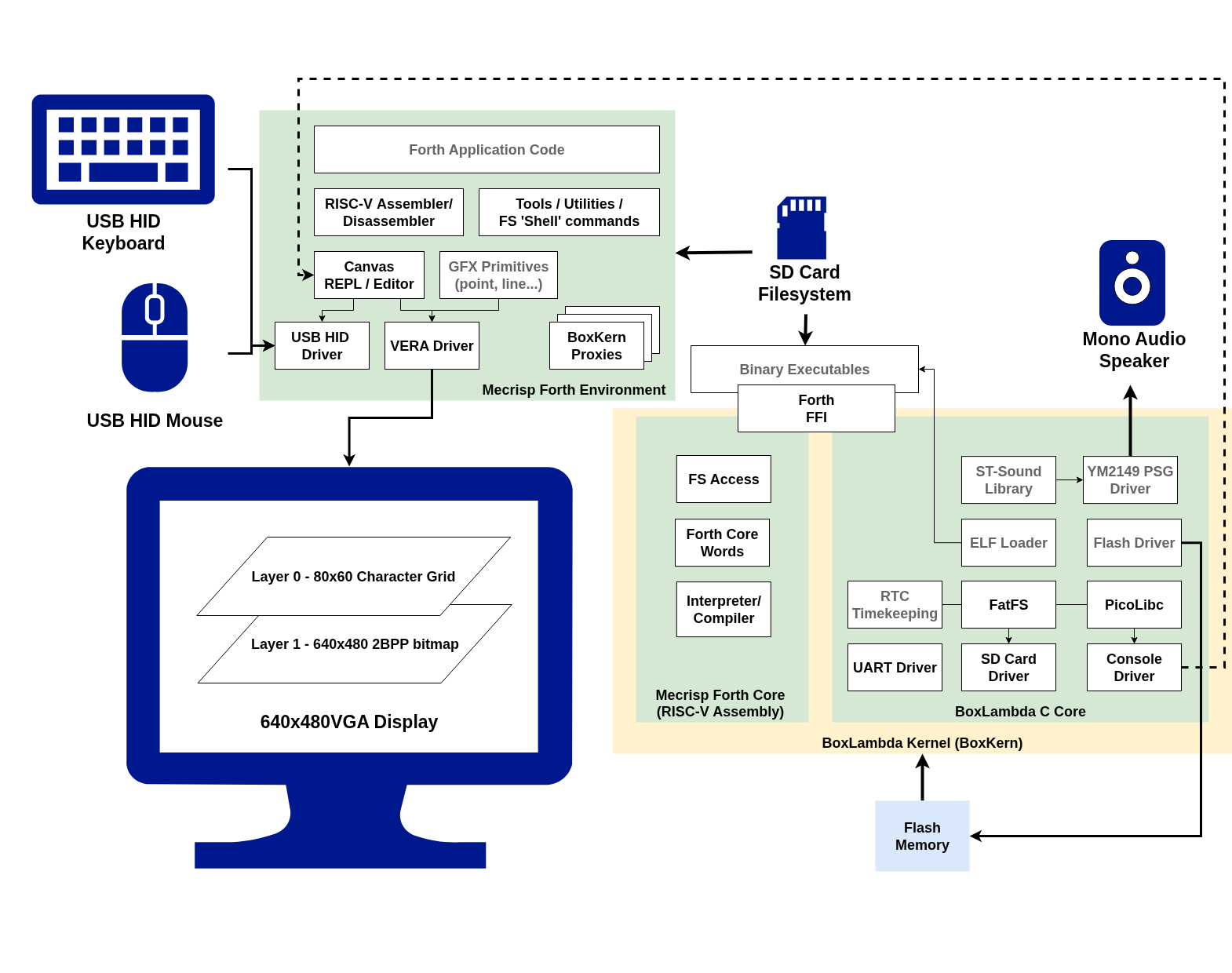
BoxLambda OS Architecture Block Diagram.
The two main subsystems are the BoxLambda Kernel (BoxKern) and the Mecrisp Forth Environment.
The BoxKern image is stored in flash memory. The Bootloader loads the kernel into EMEM, then transfers control to it. The kernel's CRT0 startup code then further unpacks specific sections into EMEM and IMEM. (See here for a more detailed description of the boot sequence).
The Mercrisp Forth Environment lives as Forth source code on the SD card filesystem.
The BoxKern
The BoxLambda Kernel is subdivided into two cores:
- The Mecrisp Forth Core, written in RISC-V assembly language.
- The C Core containing C/C++ drivers, libraries and C runtime.
The BoxKern is mostly about leveraging existing non-Forth code. Most of the BoxKern components already exist in BoxLambda's code base, the exceptions being: - The Foreign Function Interface (FFI): This is the mechanism used to call Forth from C code and C from Forth code. BoxKern drivers and libraries export their functionality to the Forth environments through the FFI. - The Console Driver: In the current BoxLambda code base, Picolibc's stdin and stdout are associated with the serial port. This I/O method has to be replaced by a Console Driver which forwards output to and takes input from the Forth-side REPL.
The Mecrisp Forth Core
The Mecrisp Forth Core is written in RISC-V assembly language. It contains Forth start-up code and the definitions of key Forth words, such as interpreter/compiler words, that make up the core of the Forth system. After booting the Mecrisp Forth Core, you have a small, operational Forth system.
I'm adding Filesystem Access (FS Access) words to the set of original Mecrisp core words so that after booting the core, the remaining Forth words can be loaded as Forth .fs source code files from the SD card filesystem. The filesystem access words are based on those found in Peter Schmid's Mecrisp Cube project.
The Mecrisp Forth Environment
 Mecrisp Forth's Welcome message - ASCII art from Adreas Freise.
Most new code will be written in Forth or in assembly language in the Forth environment. Not everything in the Forth environment is new, still- to-be-developed software, however. Some modules, such as the RISC-V assembler and disassembler, are part of the Mecrisp Forth Quintus distribution.
The Canvas REPL / Editor
Instead of a line-oriented prompt, I would like to provide a REPL that allows you to move freely all over the screen, as is the case on the Commodore 64, for instance. The Canvas REPL can perform double duty as a text editor.

The Canvas REPL.
Note that the REPL takes its input from the USB HID keyboards and sends it output to the attached VGA display. There is no serial port terminal.
The BoxKern Proxies
The BoxKern Proxies are Forth-side proxies of BoxKern drivers and libraries. The proxies access the BoxKern drivers/libs through the FFI.
The Extras
The greyed-out parts in the block diagram are components that are not essential to create a working system. These components are likely added later (some possibly never). This is just a crude binary partitioning of what really is an iterative spiraling approach. I start from something small but working (e.g., the Mecrisp Forth core running in a serial port terminal) and keep growing it. The greyed-out parts are among the parts to be added last.
Binary Executables and ELF Loader
Two such extra components are the Binary Executables and ELF Loader. I would like to have a way to extend the non-Forth part of the system without making the extension part of the kernel monolith. Lua or uLisp could be added to the system in such a way, for example. These executables can communicate with the rest of the system through the FFI.
The Display
The 640x480 display is organized into two layers. The top layer is an 80x60 character grid displaying the Canvas REPL. The bottom layer is a 2-bit-per-pixel 640x480 bitmap. The GFX Primitives module will render to this layer by default.