The RISCV-DBG Debug Core
-
RISCV-DBG Repository (BoxLambda Fork,
boxlambdaBranch): https://github.com/epsilon537/riscv-dbg -
RISCV-DBG Submodule in the BoxLambda Directory Tree:
boxlambda/sub/riscv-dbg/ -
RISCV-DBG Gateware Component in the BoxLambda Directory Tree: boxlambda/gw/components/riscv-dbg
RISCV OpenOCD
OpenOCD is an open-source software package that interfaces with a hardware debugger's JTAG port via various transport protocols. On BoxLambda, the hardware debug logic is implemented by riscv-dbg. The overall setup is illustrated below:
 OpenOCD General Setup
The RISCV-DBG Component
Riscv-dbg is part of the PULP Platform. It depends on the following repositories from the platform:
common_cells: https://github.com/pulp-platform/common_cellstech_cells_generic: https://github.com/pulp-platform/tech_cells_genericpulpino: https://github.com/pulp-platform/pulpino
As their names suggest, common_cells and tech_cells_generic provide essential building blocks like FIFOs, CDC logic, and reset logic. The pulpino dependency is minimal, limited to a few clock management cells.
To integrate these dependencies, git submodules were created under the sub/ directory in the BoxLambda repository. A Bender.yml manifest in the riscv-dbg component directory references all the necessary sources:
gw/components/riscv-dbg/Bender.yml.
The directory structure looks as follows:
boxlambda
├── gw
│   └── components
│       └── riscv-dbg
│           └── Bender.yml
└── sub
    ├── common_cells
    ├── tech_cells_generic
    ├── pulpino
    └── riscv-dbg
RISCV-DBG RTL Structure
Riscv-dbg includes two top-level modules:
BoxLambda uses a Wishbone interconnect. The ibex_wb submodule provides a Wishbone wrapper for the Ibex RISCV core. Similarly, it wraps dm_top for riscv-dbg:
wb_dm_top.sv
OpenOCD and RISCV-DBG on Verilator
In the Verilator model, the JTAG transport protocol is Remote Bitbang, a simple socket-based protocol. The protocol specification is concise and available here: Remote Bitbang Protocol
The Verilator setup is shown below:
 BoxLambda OpenOCD Verilator Setup
The hello_world project (gw/projects/hello_world/) demonstrates the OpenOCD Verilator setup. Its test script performs the following steps:
- Starts the Verilator model.
- Connects OpenOCD to the model.
- Links GDB to OpenOCD (and thus the model).
- Executes a UART register dump on the target.
- Compares the UART register values with expected results.
Relevant directory structure:
boxlambda
├── gw
│   ├── projects
│   │   └── hello_world
│   │       ├── Bender.yml
│   │       ├── sim
│   │       │   ├── sim_main.cpp
│   │       │   └── sim_main.sv
│   │       └── test
│   │           ├── test.sh
│   │           └── test.gdb
│   └── components
│       └── riscv-dbg
└── sub
    ├── common_cells
    ├── tech_cells_generic
    ├── pulpino
    └── riscv-dbg
The OpenOCD configuration file for Verilator-based debugging:
verilator.openocd.cfg
To summarize:
- The above OpenOCD config file is used to connect to the JTAG TAP of a Verilator model.
- The JTAG TAP is implemented by the
riscv-dbgcore. - The
riscv-dbgcore provides debug support for the connected Ibex RISCV32 core. - The JTAG TAP is accessed using a socket-based OpenOCD transport protocol called
remote_bitbang.
For a step-by-step guide on setting up a debug session, refer to this section.
OpenOCD and RISCV-DBG on Arty-A7 FPGA
The most straightforward approach for debugging on the Arty-A7 FPGA would be to expose the JTAG signals to PMOD pins and use a JTAG adapter. However, an alternative approach eliminates the need for a JTAG adapter. The riscv-dbg JTAG TAP can be integrated into the FPGA scan chain, typically used to program the FPGA bitstream.
On the Arty-A7, bitstream programming is done through the FTDI-based USB serial port, eliminating the need for special adapters. The riscv-dbg codebase provides two variants for this configuration:
dmi_jtag_tap.sv: Connects the JTAG TAP to external pins.dmi_bscane_tap.sv: Integrates the JTAG TAP into the FPGA scan chain using the XilinxBSCANEprimitive.
Both files implement the same module (dmi_jtag_tap) with identical ports, enabling seamless swapping. By default, BoxLambda builds the BSCANE variant for the Arty-A7.
On the OpenOCD side, the transport protocol used for this debug-access-via-FPGA-scan-chain-over-FTDI setup is called ftdi. The configuration is depicted below:
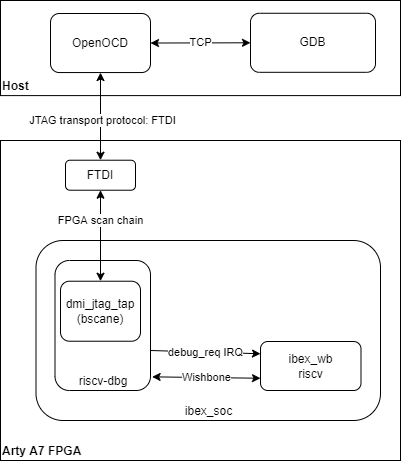 BoxLambda OpenOCD Arty A7 FTDI Setup
OpenOCD configuration files for debugging on the Arty-A7 are available in the scripts/ directory: scripts/arty_a7_100t.openocd.cfg
To summarize:
- The above OpenOCD configuration file is used to connect to the JTAG TAP of the
riscv-dbgcore. - The
riscv-dbgcore provides debug support for the connected Ibex RISCV32 core. - The JTAG TAP is integrated into the Arty-A7's FPGA scan chain (normally used for bitstream programming).
- The FPGA scan chain is accessible via the board’s FTDI-based USB serial port.
- The OpenOCD transport protocol used for this connection is
ftdi.
Starting a Debug Session on the Arty-A7
For detailed steps on setting up an OpenOCD JTAG debug session on the Arty-A7, refer to this section.
RISCV-DBG Clock Frequency
The riscv-dbg components dm_top and dmi_jtag operate in the 50 MHz system clock domain.
The JTAG clock (tck) is driven via the FPGA’s JTAG chain using the Xilinx BSCANE2 primitive. This primitive is instantiated in the dmi_bscane_tap module.